
Create an exactly 10-second vertical 9:16 photorealistic surreal food video at 24 FPS, matching a premium macro food-commercial style. Use… — a ready-to-use prompt for detailed AI video generation.
AI Video Prompt
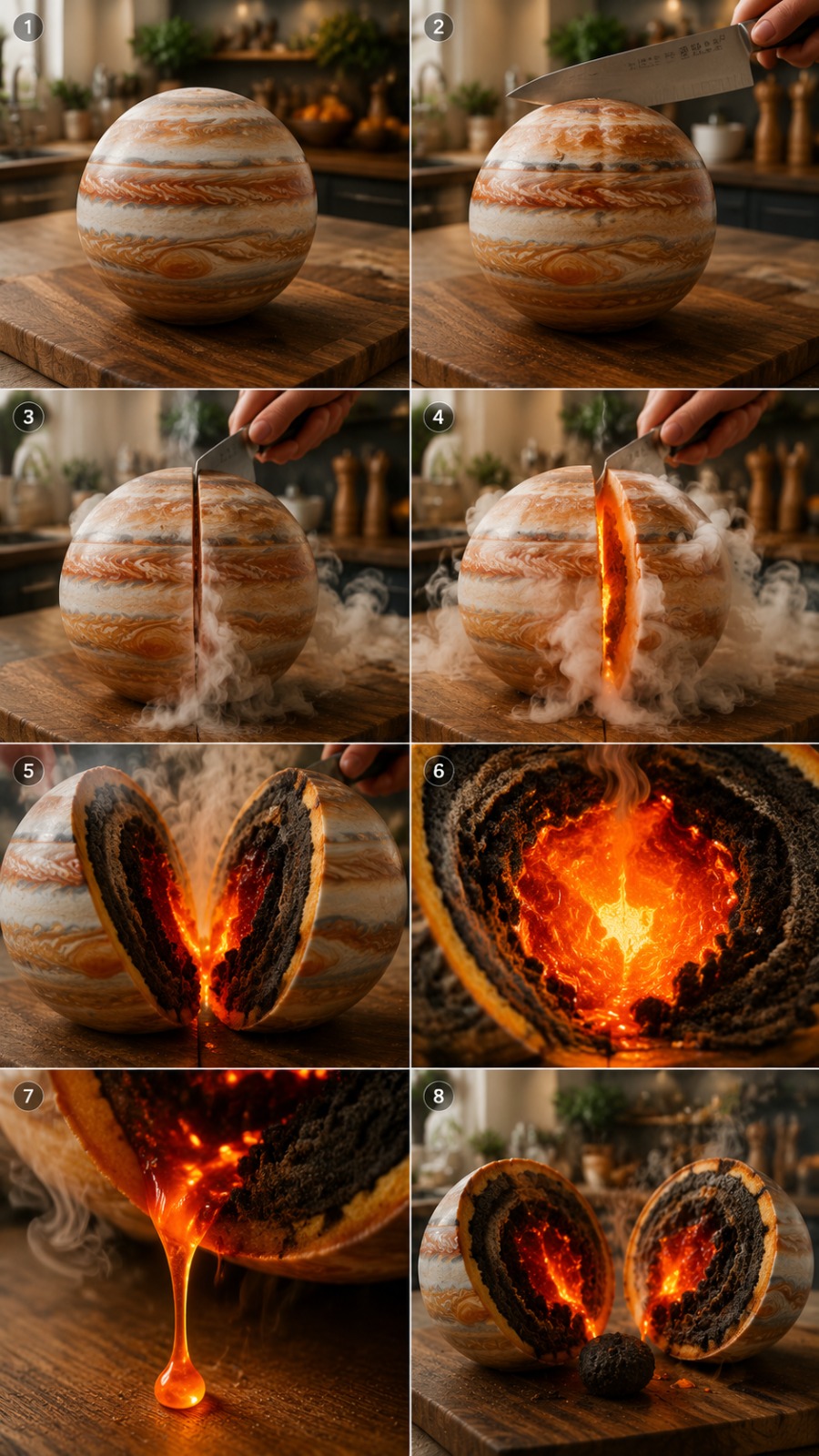
Create an exactly 10-second vertical 9:16 photorealistic surreal food video at 24 FPS, matching a premium macro food-commercial style. Use a bright modern kitchen with a thick rectangular wooden cutting board centered on a clean countertop. The board has rounded corners, beveled edges and complex warm brown swirling wood grain. In the softly blurred background, preserve a silver faucet and sink on the left, pale cabinets, a small green potted plant, a group of small orange fruits, wooden utensils, metallic cooking tools, tall kitchen containers and a pot near the stove on the right. Keep all background objects stationary. Place one perfectly round Jupiter-inspired edible sphere upright at the exact center of the cutting board. The sphere is approximately the size of a large grapefruit or small melon. It has a smooth satin surface covered with detailed horizontal planetary bands in cream, beige, tan, ochre, rust orange, gray and brown. Include several oval storm-like markings integrated into the bands. Do not add planetary rings, text or external decoration. Inside the sphere, define a layered structure that is hidden initially: A pale firm outer shell Thick charcoal-gray and dark-brown concentric inner layers Cracked rock-like channels A luminous orange-red molten interior Brilliant yellow-white highlights in the hottest central areas Use one adult right hand with warm light-to-medium skin, short natural nails and no jewelry. The hand holds one large chef’s knife with a wide reflective silver blade and dark handle. Follow this exact sequence: 0.00–2.10 seconds: Begin with the intact Jupiter-like sphere completely motionless in the middle of the cutting board. Use a locked frontal medium-close shot with a slight downward angle. Hold long enough to clearly establish the planetary stripes and round geometry. No hand or knife is visible. 2.10–2.70 seconds: The adult right hand enters smoothly from the upper-right holding the chef’s knife. The blade points diagonally downward-left toward the top-center of the sphere. Keep the grip firm and anatomically correct. 2.70–3.20 seconds: Align the knife’s sharp lower edge directly over the sphere’s vertical centerline. Lower it until the blade makes visible physical contact with the upper shell. The sphere must not move before contact. 3.20–4.00 seconds: Apply steady downward pressure. The knife penetrates the outer shell and moves vertically through the center. A narrow cut line forms exactly behind the blade. The two sides remain close together initially. 3.60–4.50 seconds: As the cut deepens, release pale cream-colored vapor from the opening. The vapor must originate only from the fresh cut. It expands into soft curled tendrils and cloud-like loops around both sides of the knife, then rises naturally. 4.00–4.90 seconds: Continue pressing the knife downward. The cut widens slightly. Through the narrow central opening, reveal dark internal layers and the first thin line of deep orange glow. 4.90–5.60 seconds: The left and right sides begin rotating outward away from the central cut. Preserve perfect alignment of all Jupiter bands across both halves. Increase the orange internal illumination as more of the interior becomes visible. 5.60–6.80 seconds: The sphere opens fully into two rounded halves resting securely on the cutting board, creating a wide V-shaped gap. Reveal dark concentric rock-like layers inside both halves. Bright molten orange and yellow liquid fills branching interior channels. A glowing ribbon connects or flows between the two sides near the center. Pale vapor continues curling upward. 6.80–7.30 seconds: Allow the halves to settle without bouncing or sliding. The molten material gathers at the lowest inner edges and begins forming a rounded central drip. 7.30–8.20 seconds: Cut or transition to an extreme macro frontal view inside the molten cavity. Fill most of the frame with dark circular layers, glowing orange channels, a bright yellow-white central pool and thin pale vapor wisps. Keep the lava slow, viscous and glossy. Do not show an explosion. 8.20–9.15 seconds: Cut to a macro side view of the lower broken edge of one half. Show a thick orange droplet forming beneath the edge, elongating downward into a narrow luminous strand and touching or nearly touching the wooden board. The glow softly lights the surrounding shell and board grain. 9.15–10.00 seconds: Return to a wider frontal view of both halves resting open on the cutting board. The interiors remain glowing orange-yellow. Pale cream vapor rises from both sides. A small dark round or irregular fragment is visible between or directly below the halves, consistent with the reference. Hold the final composition until the last frame. Use physically realistic cutting resistance, shell separation, vapor buoyancy, molten-liquid viscosity, gravity, surface tension and emitted orange light. No dialogue, no extra hands, no unrelated food, no extra actions and no changes to the kitchen environment. Audio: Dialogue, music, ambience and sound effects are Unclear. Preserve the original reference audio when available and do not invent spoken words.

Social Plugin