
Create a 10.00-second vertical 9:16 photorealistic botanical macro timelapse at 24 fps. Show one large flattened prickly pear cactus pad… — a ready-to-use prompt for detailed AI video generation.
AI Video Prompt
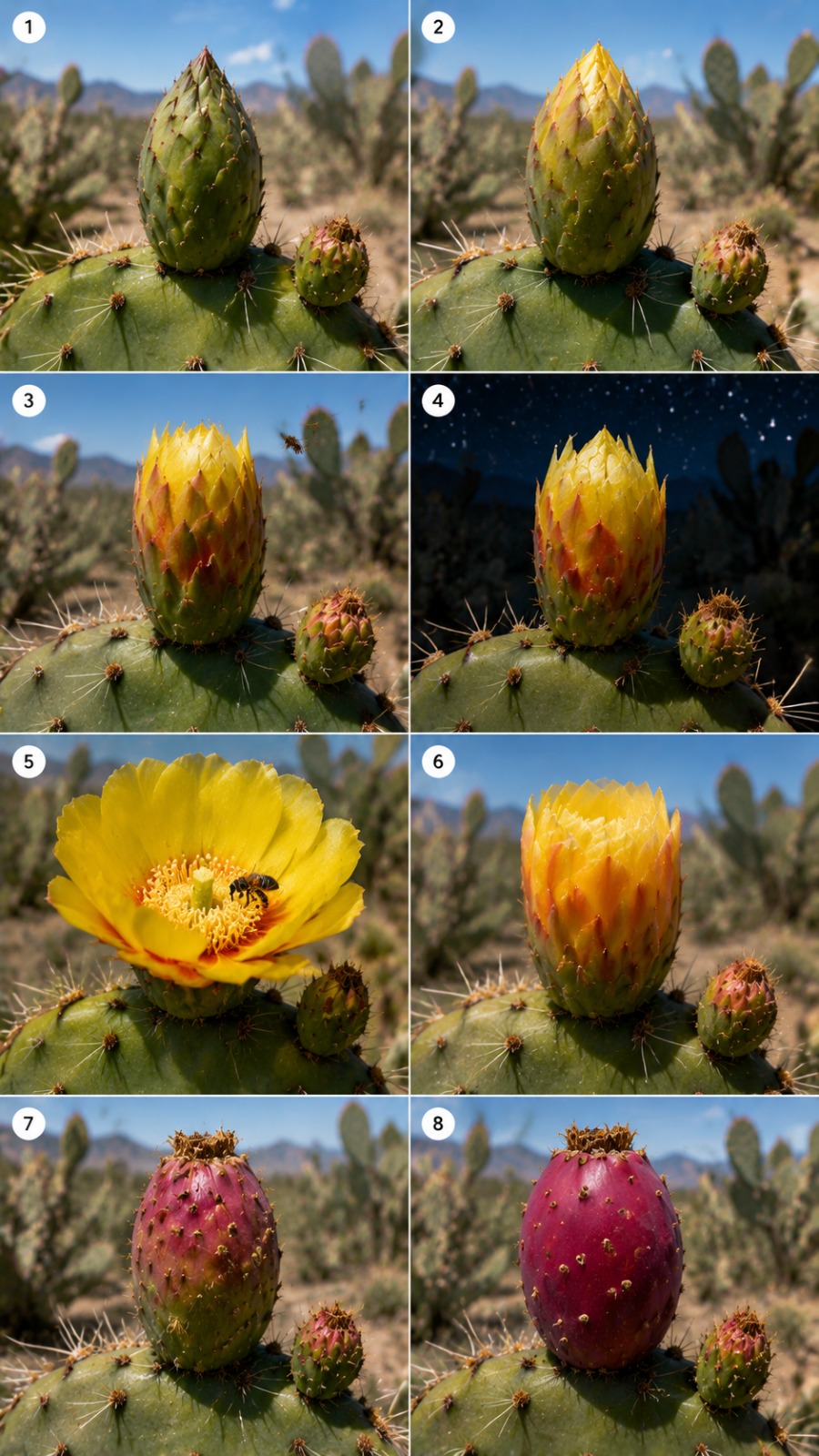
Create a 10.00-second vertical 9:16 photorealistic botanical macro timelapse at 24 fps. Show one large flattened prickly pear cactus pad filling the lower two-thirds of the frame in a dry desert environment. The pad is green to blue-green with a matte waxy surface. Cover it with evenly spaced round brown-yellow areoles, each carrying several long pale cream spines and small brown bristle clusters. Place one primary unopened flower bud near the upper-left-center ridge of the pad. Place one smaller unopened bud lower and slightly to the right. Keep both attached to fixed cactus areoles. Use a locked macro camera with approximately 85–120 mm lens appearance, shallow depth of field, and focus on the primary bud. In the blurred background, show additional prickly pear pads, sandy ground, dry shrubs, distant low mountains, and a clear blue sky. 0.00–1.00 seconds Begin with the main flower bud compact, green, and pointed. The overlapping outer bracts are tightly closed. Only a very small hint of pale yellow is visible near the upper tip. The bud subtly swells while remaining fixed to the cactus. 1.00–2.00 seconds The main bud becomes taller and wider. Separate the upper green bracts slightly. Reveal more yellow petal tips between them. Bend several outer bracts outward by a few degrees. Keep the smaller lower-right bud closed and unchanged. 2.00–3.00 seconds Continue enlarging the central bud. Push yellow petals upward through the green bracts. The upper tip becomes a layered yellow-green crown. Allow one very small dark flying insect to pass briefly near the right or upper side of the bud, but do not let it dominate the shot. 3.00–4.00 seconds Create a brief accelerated-time transition. Darken the sky and overall scene into a cool blue-grey evening or night-like appearance. Add many tiny bright white points across the upper background, resembling stars or stylized timelapse light points. During this transition, keep the camera and cactus completely fixed. The yellow petals continue separating and begin curling outward. 4.00–5.00 seconds Return smoothly to bright desert daylight. Open the flower rapidly and organically. Unfold broad pale-yellow petals in multiple radial layers. Move the outer petals outward and slightly downward. Reveal warm orange-red markings near the inner petal bases. Expose a dense center filled with cream and yellow stamens. 5.00–6.00 seconds Reach the fully open flower state. The bloom is broad and circular, with layered yellow petals surrounding the bright central stamen cluster. Use realistic translucent petal edges and fine natural texture. A small dark bee-like or fly-like insect approaches and hovers briefly above or near the flower center. Exact insect species does not need to be identifiable. 6.00–7.00 seconds The insect leaves the central area. Begin closing the flower rapidly. Lift the outer petals upward. Curl their tips inward. Compress the inner petals around the stamens. Reduce the flower diameter until it resembles a tall folded yellow crown surrounded by green and pinkish bracts. 7.00–8.00 seconds Complete the flower closure. The yellow petals become almost completely enclosed. The outer bracts shift from green toward pale pink and dusty red. Begin swelling the closed flower base. Transform the structure gradually into a smooth upright oval while retaining visible circular cactus areoles. 8.00–9.00 seconds Expand the developing fruit. Increase its height, width, and volume. Shift the surface color from pink-red into rich burgundy and purple-red. Keep short pale spines and tiny bristle clusters growing from evenly distributed areoles. Preserve a small dried floral remnant near the top. 9.00–10.00 seconds Hold the mature prickly pear fruit. The fruit is oval, plump, saturated purple-red, and attached firmly to the same cactus pad. Use warm sunlight from screen-left, creating a bright edge highlight and deeper burgundy shadow on the right. Keep the smaller lower-right bud and all cactus spines unchanged. Hold the final fruit clearly until the last frame.

Social Plugin