
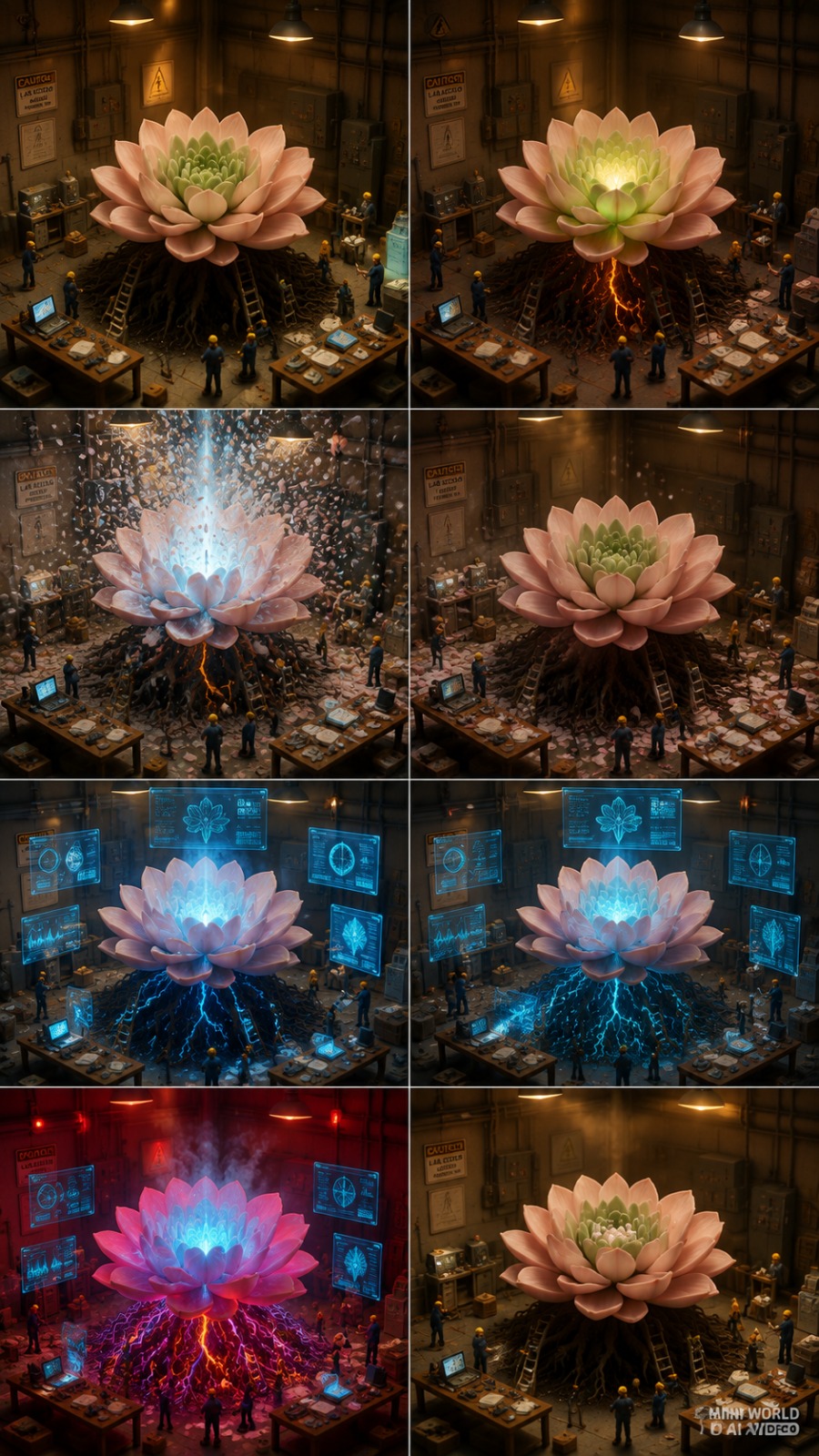
Create an approximately 7.85-second vertical 9:16 photorealistic miniature science-fiction laboratory video at 30 FPS, using one continuous… — a ready-to-use prompt for detailed AI video generation.
AI Video Prompt
Create an approximately 7.85-second vertical 9:16 photorealistic miniature science-fiction laboratory video at 30 FPS, using one continuous fixed camera shot with no pan, tilt, dolly, orbit, zoom, handheld shake or reframing. Show an enclosed industrial botanical research laboratory viewed from a high frontal angle. The room has warm brown-gray walls, overhead industrial lamps, exposed pipes, electrical cabinets, technical panels, warning signs and workstations. Place one enormous succulent-like flower exactly at the center. The flower resembles a giant echeveria or lotus-shaped rosette. Its features must remain consistent: Multiple layers of thick rounded outer petals Pale blush-pink outer petals Smaller mint-green inner petals Smooth soft satin texture Wide symmetrical rosette shape Dense exposed dark-brown and black root ball beneath it Thick intertwined roots and thin branch roots Dark soil embedded between roots No visible stem or leaves Surround the plant with approximately eight to ten miniature adult laboratory workers. Most wear blue work clothing, dark trousers, yellow safety helmets and dark work boots. Distribute them consistently: Several workers near the front worktables One or more workers on the left side One or more workers on the right Some beside or on miniature ladders Others near laboratory equipment and root sensors Use multiple wooden or metal worktables in the lower-left, lower-right and side areas. Place papers, notebooks, tools, small cases and technical instruments on the tables. Add several brown crates near the lower foreground. Place miniature ladders against the root mass and flower base. On the rear wall, show warning signs with large readable headings resembling “CAUTION” and “LAB ACCESS ONLY,” but do not invent smaller unreadable wording. Use warm industrial ceiling lamps for the opening state. Preserve all furniture, workers, wall objects and flower geometry for the full video. Follow this exact action sequence: 0.00–0.70 Seconds Begin with the giant flower calm and fully open. Its outer petals are pale pink and its inner rosette is mint green. All miniature workers are already present, facing the flower, tables or monitoring equipment. The room is illuminated by warm amber industrial light. The dark exposed roots remain unlit and stationary. 0.70–1.40 Seconds Create a subtle pale-yellow glow deep inside the mint-green flower center. Increase the internal glow gradually without moving the outer petals. Allow a faint warm orange light to appear inside a small central portion of the exposed roots beneath the blossom. Workers remain at their stations. 1.40–1.90 Seconds Increase the flower-center brightness from pale yellow to warm yellow-white. Begin forming a pale cyan-white energy haze between the central petals. The orange glow inside the roots becomes more visible. Do not move the camera or laboratory props. 1.90–2.20 Seconds Release a strong pale-blue and white energy plume straight upward from the flower center. The plume pushes through the central petals and expands vertically. Inner petals begin lifting and separating because of the upward force. 2.20–2.85 Seconds Trigger the main petal eruption. Hundreds of small pale-pink and white petal fragments burst upward and outward from the blossom center. Several larger pale petal pieces also separate. The particle cloud must fill the upper-middle frame while remaining centered on the flower. The giant outer petals become partially obscured and temporarily appear compressed or reduced around the center. The workers, ladders and tables remain stationary. No worker is hit or thrown. 2.85–3.35 Seconds Allow the petal fragments to slow and fall under gravity. Fragments descend around the flower, workers, tables, crates and root mound. Some pieces land on the floor and work surfaces. The central energy plume fades. The flower appears temporarily flattened or depleted in its upper layers. 3.35–4.00 Seconds Rapidly reconstruct the flower. The detached and missing petal layers return inward or regrow smoothly from the center. Restore the exact original pale-pink outer rosette and mint-green inner petals. Leave a small cluster of fine pale fragments visible in the center and scattered debris on nearby surfaces. Restore the warm neutral laboratory lighting. 4.00–4.65 Seconds Activate futuristic blue holographic diagnostic displays around the flower. Materialize several translucent cyan-blue rectangular screens at different heights: One upper-center screen One upper-left screen One upper-right screen Several mid-left and mid-right screens Additional smaller lower screens Display only abstract technical imagery: Circular scans Plant diagrams Waveforms Cross-sectional graphics Interface lines Do not generate readable technical sentences. Blue light from the screens must reflect naturally on the flower, workers and room. 4.65–5.40 Seconds Illuminate the exposed root network with bright electric cyan energy. The glow begins near the flower base and travels downward through the existing roots. Branch the blue light naturally through every major root path. Add cyan illuminated outlines around parts of the floor and equipment base. Keep all roots physically stationary. 5.40–5.95 Seconds Increase the intensity of the cyan root network and holographic interfaces. Create cool blue reflections on the lower pink petals and nearby helmets. The screens remain stable and do not pass through the flower. 5.95–6.30 Seconds Activate red emergency ceiling lights abruptly. The entire laboratory becomes dark red while the holographic screens remain blue. Illuminate walls, tables, workers and petals consistently with the red alert lighting. Do not move any objects. 6.30–6.80 Seconds Transform the root energy from cyan into a mixture of: Bright yellow near the center Hot pink Violet-purple Residual cyan-blue Make the multicolored energy rise from the roots into the flower base. Increase the flower-center glow to bright cyan-white. Begin forming pale vapor around the blossom. 6.80–7.20 Seconds Reach peak energy. The flower center and several inner petals glow intensely blue-white. Soft cyan and pink energy highlights spread through the lower petals. The root network glows yellow, pink and purple. Pale vapor curls gently around the blossom without hiding its shape. The red emergency lighting remains active. The holographic screens fade or become less prominent. 7.20–7.55 Seconds Begin shutting down the experiment. Reduce the root energy and flower glow. Remove the holographic screens. Fade the pale vapor. Turn off the red emergency lighting. 7.55–7.85 Seconds Return completely to the original warm industrial lighting. Restore the flower to its normal pale-pink outer petals and mint-green center. Remove all neon root illumination. Keep the workers, ladders, tables, crates and wall equipment in their original positions. Leave a small pale cluster or residual fragments in the flower center, matching the final reference appearance. Hold the restored laboratory composition until the final frame. Physical Rules The flower must remain rooted throughout. Workers must remain at miniature scale. Petals must originate from the flower center. Falling petals must respond to gravity. Regeneration must restore the original flower geometry. Holographic screens must float without physical support. Root energy must follow existing root branches. Colored light must illuminate nearby surfaces. No object may teleport or change location. No worker may duplicate or disappear. No laboratory structure may deform.

Social Plugin