
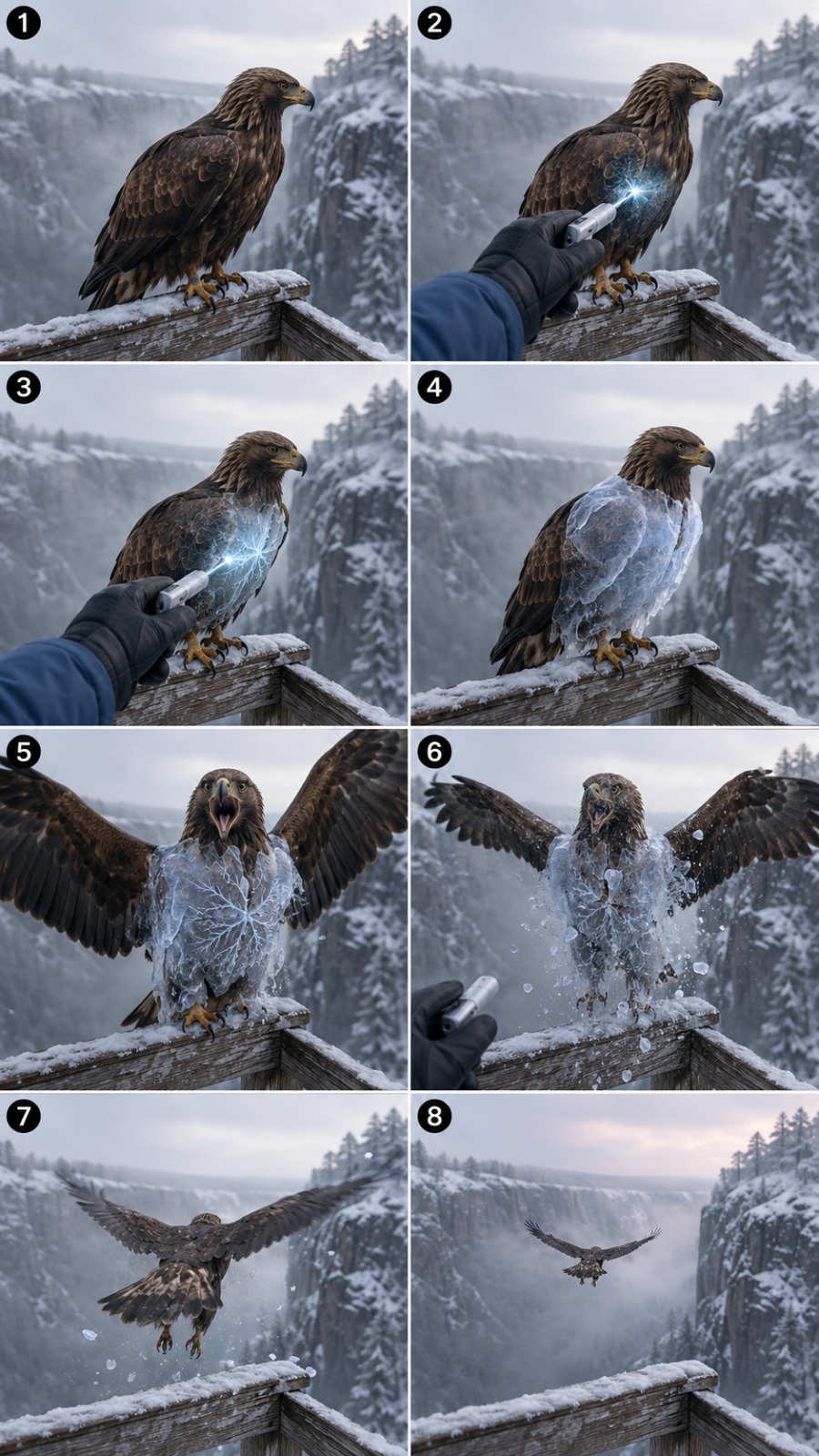
Create an approximately 6-second vertical 9:16 hyper-realistic first-person handheld wildlife fantasy video in one continuous uninterrupted… — a ready-to-use prompt for detailed AI video generation.
AI Video Prompt
Create an approximately 6-second vertical 9:16 hyper-realistic first-person handheld wildlife fantasy video in one continuous uninterrupted shot with no cuts. Begin with one large adult brown mountain eagle already perched upright on the snow-covered corner of a weathered dark wooden lookout railing high above a fog-filled snowy canyon. Lock the eagle’s appearance throughout: gray-brown rounded head, streaked cream-and-brown neck, mottled dark brown chest, broad dark brown folded wings with lighter feather edges, one clearly visible bright yellow eye, a large hooked golden-yellow beak with a dark tip, strong yellow legs and long curved black talons. The eagle faces mostly toward screen-right at the opening, calm but vigilant, while a steep reddish-gray snow-covered cliff remains fixed along the left background and dense cold white-gray mist fills the canyon behind it. In the lower-left foreground, show only one adult operator’s arm wearing the same blue winter jacket sleeve and thick gray-black insulated glove. The gloved hand brings one compact white-and-gray handheld nozzle-like device toward the eagle’s left-front chest and holds its tip within direct contact or only a few centimeters from the feathers. The freezing effect must originate only from this device tip: a small bright cyan-white point appears on the center-left chest and rapidly expands into dozens of thin radial crystalline frost lines spreading across the eagle’s front torso, followed by pale-blue semi-transparent ice thickening naturally around the chest and lower abdomen while the original eagle remains visible underneath and its feet remain firmly connected to the snowy railing. As the ice expands, the eagle turns its head from screen-right toward the camera and device, widens its intense yellow eye, opens its hooked beak in a distressed defensive reaction and begins raising both shoulders and unfolding both wings. The operator lowers or withdraws the device as the eagle forcefully spreads its broad wings outward and upward, pushes its chest and body against the frozen layer and breaks through the ice. Synchronize the wing expansion with a sharp realistic fracture: the ice shell cracks from the chest contact point, bursts into small pale-blue and white fragments, and loose snow scatters downward and sideways under gravity and the force of the wings. The eagle leans forward, releases one yellow talon and then the other from the wooden rail, pushes off powerfully and lifts clear of the railing with both wings fully extended, legs briefly hanging naturally below its body. Continue the same handheld camera position at the lookout with only a small natural follow movement as the eagle flies directly away from the camera into the center of the misty canyon using broad realistic wing strokes, becoming progressively smaller with distance while the snowy wooden railing remains visible in the lower foreground and the rocky cliff remains fixed on the left. Preserve the subtle transition from cold blue-gray fog to the pale pink-tinted mist visible during the final flight without changing the location. Use soft diffuse overcast winter daylight, realistic feather detail, accurate talon contact, natural snow displacement, physically coherent ice refraction, correct occlusion, mild motion blur on wings and flying fragments, and low-to-moderate mobile camera shake. Preserve the reference audio if supported; otherwise use only cold mountain wind, a brief device activation/freezing hiss, crystalline frost buildup, an unclear nonverbal eagle cry, sharp ice cracking, heavy wing flaps and a fading flight whoosh, with no invented human dialogue, music lyrics or narration.

Social Plugin