
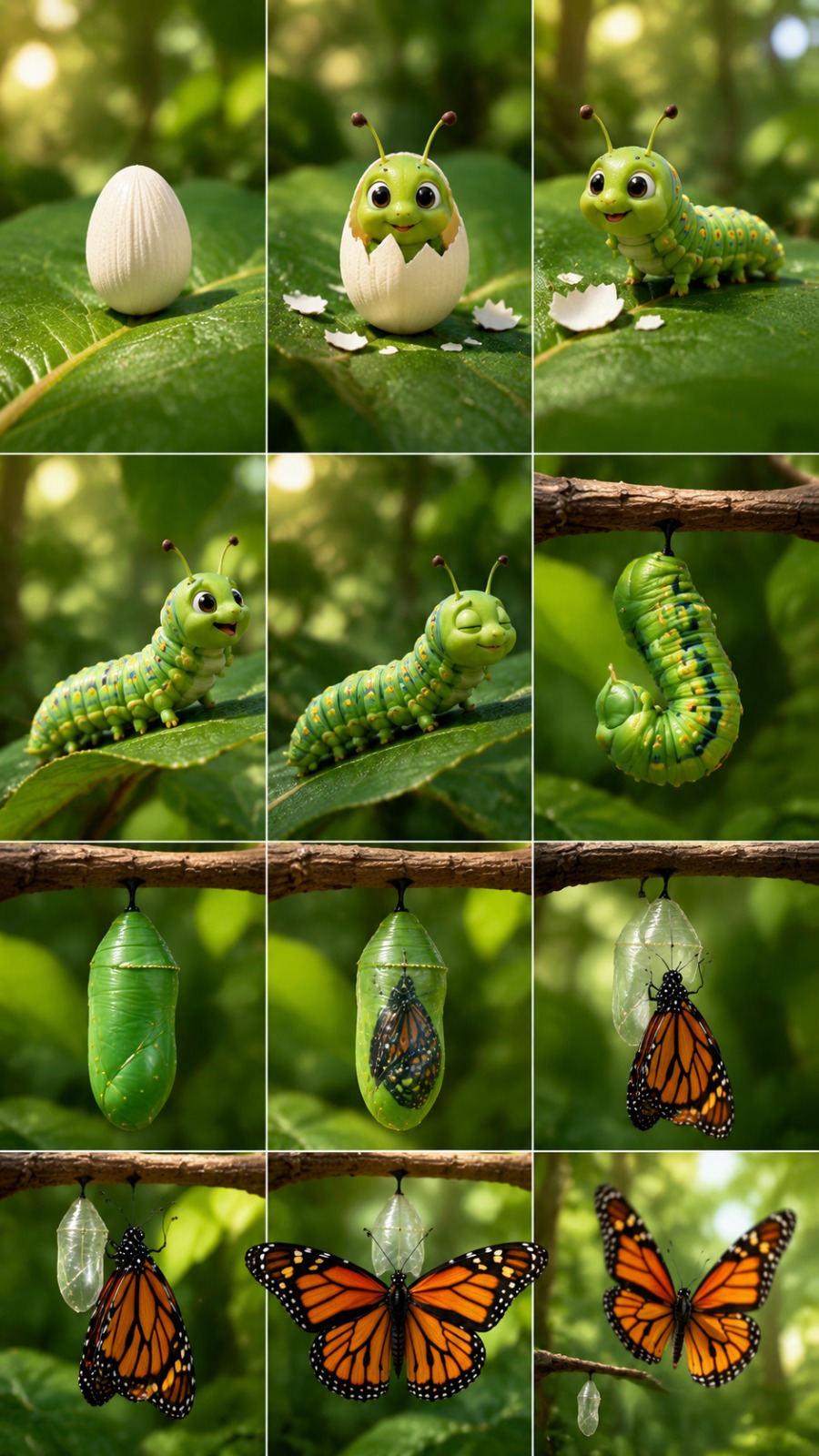
Create a 10.24-second vertical 9:16 polished stylized 3D CGI butterfly-life-cycle animation with realistic macro forest foliage, soft… — a ready-to-use prompt for detailed AI video generation.
AI Video Prompt
Create a 10.24-second vertical 9:16 polished stylized 3D CGI butterfly-life-cycle animation with realistic macro forest foliage, soft natural sunlight and shallow depth of field. Use one insect represented sequentially as a white egg, a cute green caterpillar, a suspended chrysalis and an orange-and-black butterfly. 0.00–0.45 seconds Open on one smooth white oval egg standing upright near the center of a broad textured green leaf. Use a macro three-quarter view slightly above leaf height. The leaf fills most of the lower frame and shows clear veins and softly serrated edges. Place blurred green forest foliage and warm circular bokeh in the background. Keep the camera stable. 0.45–1.35 seconds Create a dark zigzag crack around the upper third of the egg. Expand the crack gradually. Separate several irregular shell pieces and let them fall naturally onto the leaf around the egg. Keep the lower shell half upright. 1.35–2.20 seconds A small cute green caterpillar rises from inside the broken egg. Show its two thin green antennae with dark rounded tips first, followed by its large glossy eyes, rounded green head and smiling mouth. Its front body emerges while the rear remains inside the shell. Keep broken white shell pieces visible on both sides. 2.20–3.30 seconds The caterpillar climbs completely onto the leaf. Give it a plump segmented light-green body, blue-green side stripes, small yellow-orange side dots and short yellow-green feet. It pauses near the broken shell, briefly closes its eyes with a peaceful smile, then opens them and looks toward screen-right. 3.30–3.60 seconds Use a soft cross-dissolve to transition into the same caterpillar at a slightly larger and more mature size on a similar green leaf. Preserve the exact face, eyes, antennae, markings and overall color palette. 3.60–5.40 seconds Show the larger caterpillar crawling slowly toward screen-right. Animate realistic caterpillar locomotion: front feet reach and grip, central body segments compress, rear segments push forward, and the body extends again. Keep its head slightly raised, mouth cheerfully open and antennae angled upward. Around the end of this section, let its eyes gently close. 5.40–5.80 seconds Use another soft dissolve. Transition from the crawling pose to the caterpillar beneath a horizontal textured brown branch near the upper frame. 5.80–6.30 seconds Attach the caterpillar’s rear end to the underside of the branch at one small dark silk attachment point. Curl its body upward into a J-like hanging posture. Keep its eyes closed and body relaxed. 6.30–7.25 seconds Form a pale teal-green translucent chrysalis directly around the hanging caterpillar. The casing should grow continuously from the upper body downward, smooth over the segmented shape and become a tapered hanging teardrop. Brief pale folded outer material may appear around the upper sides during closure, but the final chrysalis must be smooth, glossy and fully sealed. Add tiny yellow-orange decorative dots and faint horizontal contour lines. Keep it attached to the same branch. 7.25–8.05 seconds Gradually make the chrysalis more transparent. Reveal the tightly folded adult butterfly inside. Show dark body shapes and orange-and-black wing patterns becoming visible through the green-blue shell. Do not show the wings fully open. 8.05–8.95 seconds Split the lower chrysalis naturally. Let the butterfly push downward and emerge head-first. Show its slender dark body and orange folded wings hanging vertically below the shell. The butterfly remains attached to or gripping the empty chrysalis. Preserve gravity and keep the branch stationary. 8.95–9.70 seconds Rotate or settle the butterfly into a frontal hanging position. Expand both wings gradually and symmetrically. Start with narrow folded wings, then unfold the upper wings, flatten the lower wings and reveal the full pattern: bright orange panels, black branching veins, thick black borders and small white edge spots. 9.70–10.24 seconds Hold the butterfly briefly with both wings fully open across the center of the frame. Then begin gentle wing flaps and let the butterfly rise upward toward the top edge, partially leaving the frame. Keep the empty translucent chrysalis hanging beneath the branch in the background. Use stable macro composition, warm forest daylight, realistic leaf texture and soft green-gold bokeh. Keep character design friendly, glossy and child-safe. Use only the visible soft transitions. Do not add dialogue because the original dialogue is Unclear. Preserve original reference audio when available.

Social Plugin